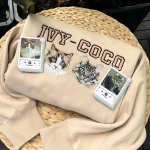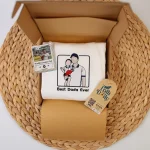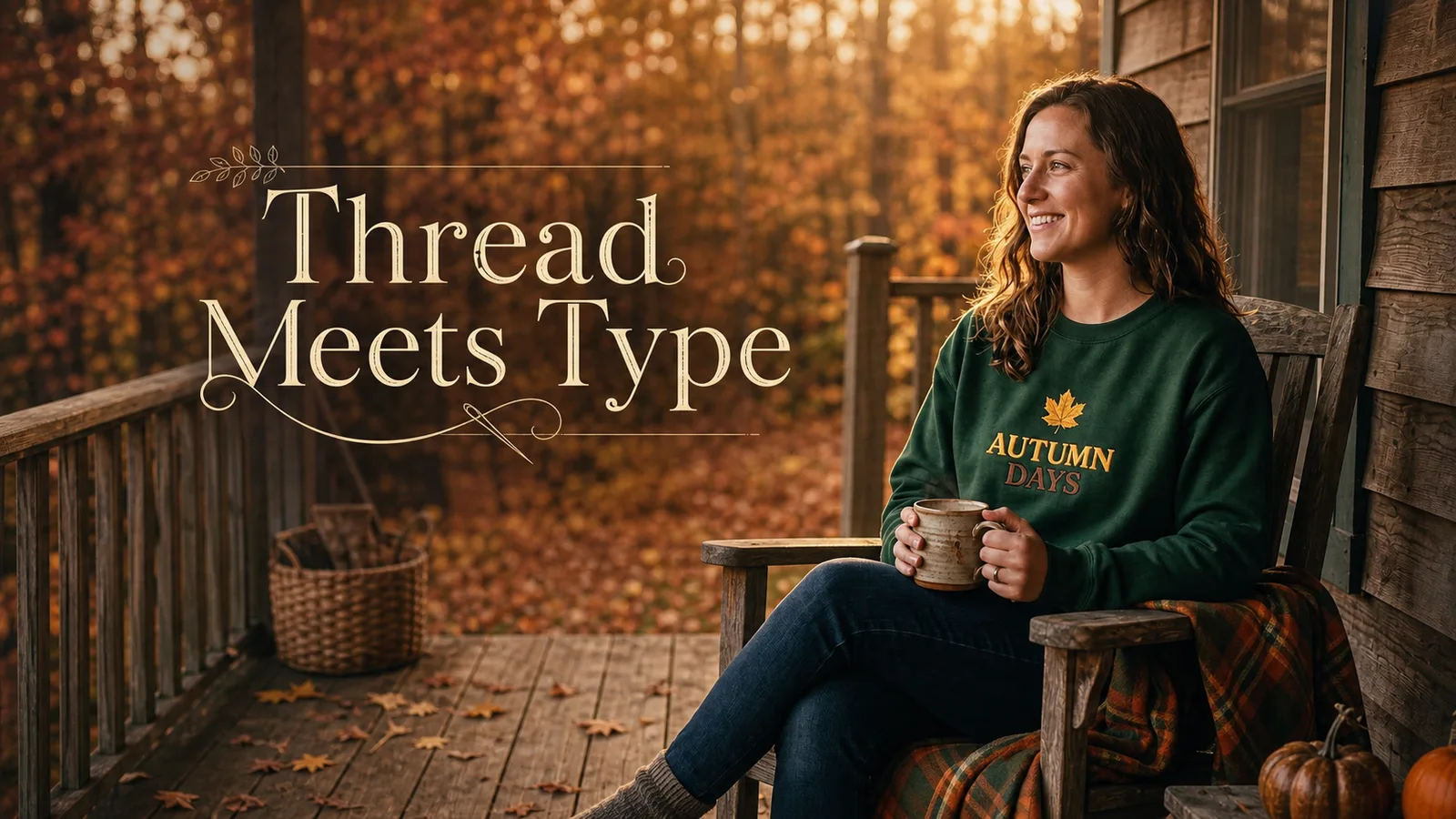
You’ve picked the perfect design, loaded up the machine, and hit start—only to watch a beautiful script font turn into a tangled mess of thread. This happens because standard digital typefaces are often too thin, too small, or too detailed for the physical reality of stitching on thick fabric. Finding the best fonts for embroidered sweatshirts isn’t just about aesthetics; it’s about choosing letterforms that won’t close up, sink into the fleece, or break during the sewing process.
- The safest choices for embroidered sweatshirts are clean, sans-serif block fonts.
- Always check a font's recommended minimum stitch height—standard 40-weight thread needs at least 6 mm.
- Script fonts must be bold, simple, and scaled up to avoid thin connectors from disappearing.
- Fleece and sweatshirt knits always require a stabilizer and a topping to keep stitches on the surface.
Why most digital fonts fail on a sweatshirt
Most digital fonts have delicate serifs and thin connectors that translate poorly into thread, which lacks the precision of digital pixels. For embroidered sweatshirts, clean block and sans-serif fonts are the safest choices because they avoid fragile decorative terminals that easily close up.
Sans-serif fonts, by definition, lack those small protruding features called serifs Wikipedia – Sans-serif. Because thread has a physical thickness and the needle creates a small hole, any stroke narrower than a certain threshold will either disappear into the fabric or fail to stitch clearly. This is why an Arial-style or basic block font is almost always a better bet than a delicate Times New Roman.
Standard 40-weight thread needs a minimum block letter height of about 6–7 mm to stitch cleanly.— Madeira USA
Wilcom notes that fonts converted from TrueType often have lowercase letters that are only about 70% of the capital letter height. This makes them too small to stitch neatly unless you specifically enlarge them Wilcom EmbroideryStudio Font Inclusions.
Choosing the right font by your project
Different fonts serve different purposes on a sweatshirt; a tiny name tag needs a different structure than a bold chest statement. Here are the best font styles categorized by their specific use cases.
| Use Case | Best Font Style | Key Consideration |
|---|---|---|
| Small Names/Tags | Small Block / Helvetica-style Sans | Needs a minimum of 6 mm letter height for 40wt thread. |
| Bold Chest Text | Athletic Block / Varsity Slab / Condensed Block | Keep it simple and bold to stand out against the knit. |
| Premium Minimalist | Montserrat / Arial-style Geometric Sans | Clean lines and uniform stroke widths stitch best. |
| Large Statement Scripts | Thick Brush / Chain-stitch Style Script | Must be scaled up so thin connectors don't break. |
| Monograms | Sturdy Serif / Interlocking Alphabets | Sturdy serifs hold up better than delicate ones. |
Best font styles for specific sweatshirt designs
When you want a premium, minimalist look, geometric sans-serif fonts like Montserrat or Arial are excellent. For bold athletic vibes, varsity block fonts give that classic collegiate feel without risking thread breakage.
When to use a script font (and how to save it from disaster)
Script fonts work on sweatshirts for names or statement words, but they must be bold, simple, and significantly larger than standard block text. Thin connectors and high-contrast strokes are prone to merging or disappearing in fleece.
If you’re using a script font for a custom order, like adding a name to a horse portrait sweatshirt, choose a design with thick, uniform strokes. Avoid scripts with hairline connectors or complex swashes. As Wikipedia explains, script typefaces are inspired by handwriting, which works beautifully on paper but becomes a structural nightmare when reduced to thread on a stretchy knit.
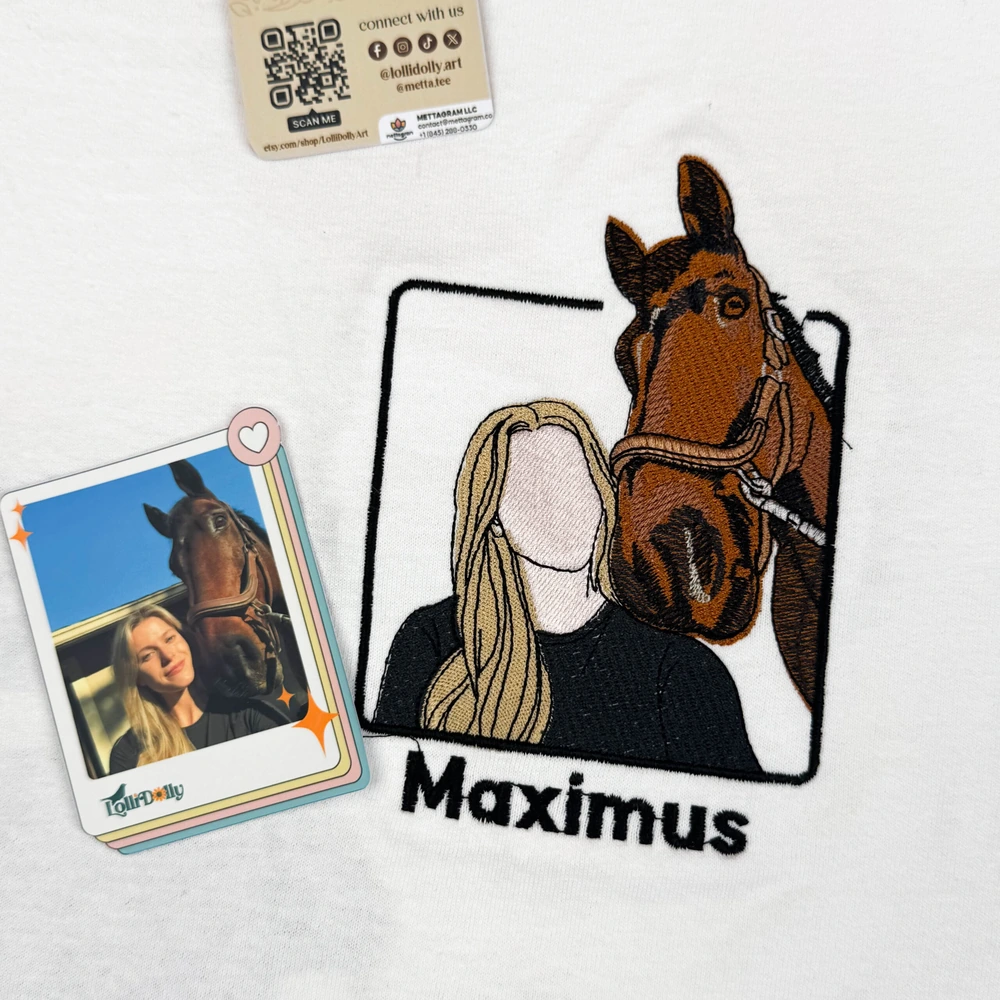
A beautiful custom gift for horse lovers that relies on clean, sturdy lettering to complement the detailed portrait.
If a script font varies wildly between thick and thin strokes, it will break on a sweatshirt. Choose a brush-style or monoline script instead for the most reliable results.
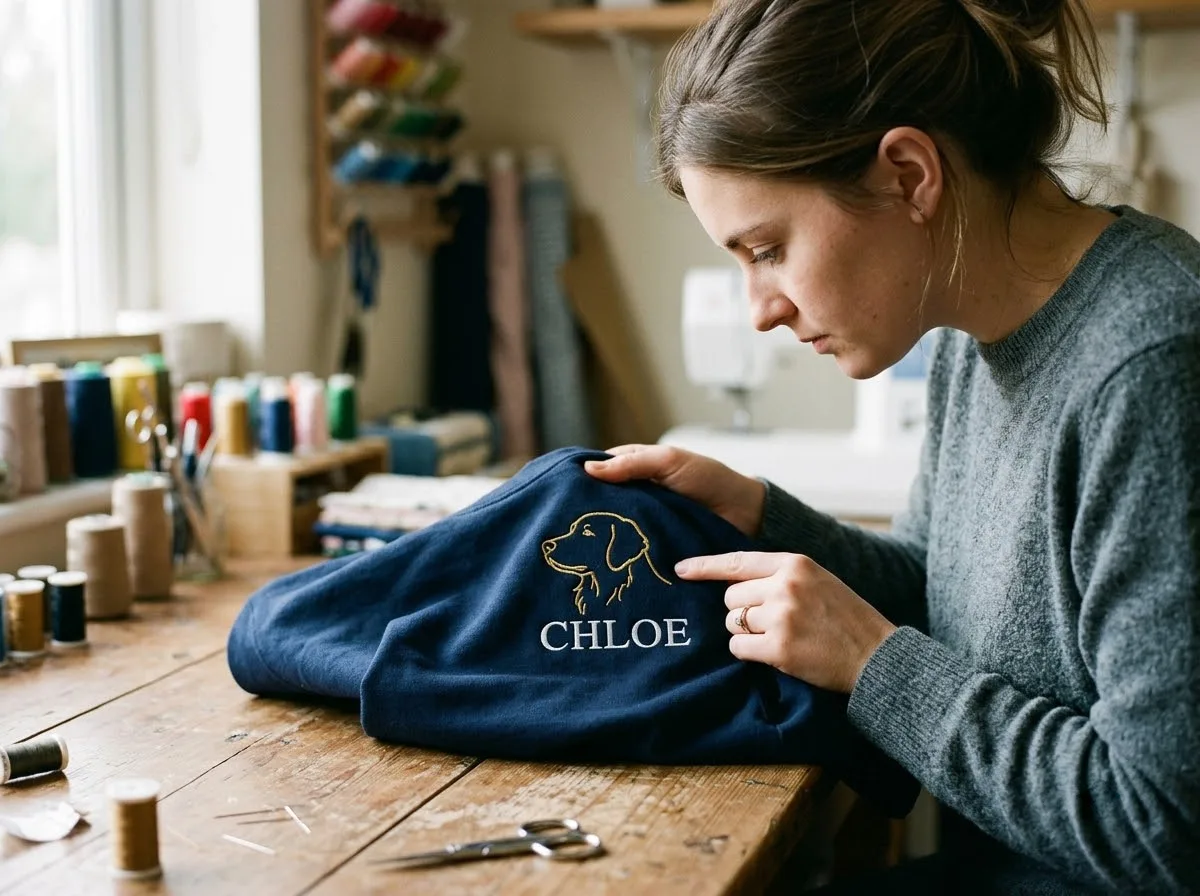
The stabilizer and topper rules for sweatshirt fabric
Because sweatshirt fleece has a fuzzy, raised surface (the nap), you cannot sew directly onto it without stabilization. You need a cut-away stabilizer underneath and a light topping on the surface to keep the stitches from sinking into the nap.
Singer’s embroidery reference guide specifically recommends a cut-away stabilizer, spray adhesive, and a topper for dense designs on fleece SINGER Embroidery Quick Reference Guide. This is echoed by Craftsy, which recommends a light water-soluble topping so the thread doesn’t sink into the fabric’s surface.
- Stabilizer: A cut-away stabilizer (unlike tear-away) stays permanently attached, providing ongoing support for the stitches as the sweatshirt stretches.
- Topping: A water-soluble topping (like Solvy) sits on top of the fleece during sewing and is dissolved away afterward, preventing the thread from sinking.
- Adhesive: A light spray adhesive helps keep the fabric and stabilizer from shifting during the embroidery process.
A real-world guide to thread weights and needle sizes
The standard thread weight for most machine embroidery is 40-weight, which requires a minimum block letter height of about 6–7 mm. If you need to stitch smaller text, switching to 60-weight thread allows you to reduce the size to about 3 mm while preserving clarity.
When working with finer thread like 60-weight, you must also adjust your equipment. According to Madeira USA, you need a #65 needle and carefully adjusted tension to prevent the finer thread from breaking.
| Metric | 40-Weight Thread | 60-Weight Thread |
|---|---|---|
| Minimum Letter Height | 6–7 mm | ~3 mm |
| Recommended Needle | #75/11 or #80/12 | #65/9 |
| Best For | Standard chest text, names, bold scripts | Very small text, detailed monograms, intricate borders |
Standard vs. fine thread for small text
Always check the font documentation before sizing. As Brother’s PE-DESIGN documentation notes, only built-in small-text fonts should be used for those specific patterns, and the interface displays a recommended size for each one Brother PE-DESIGN 11: Small Text.
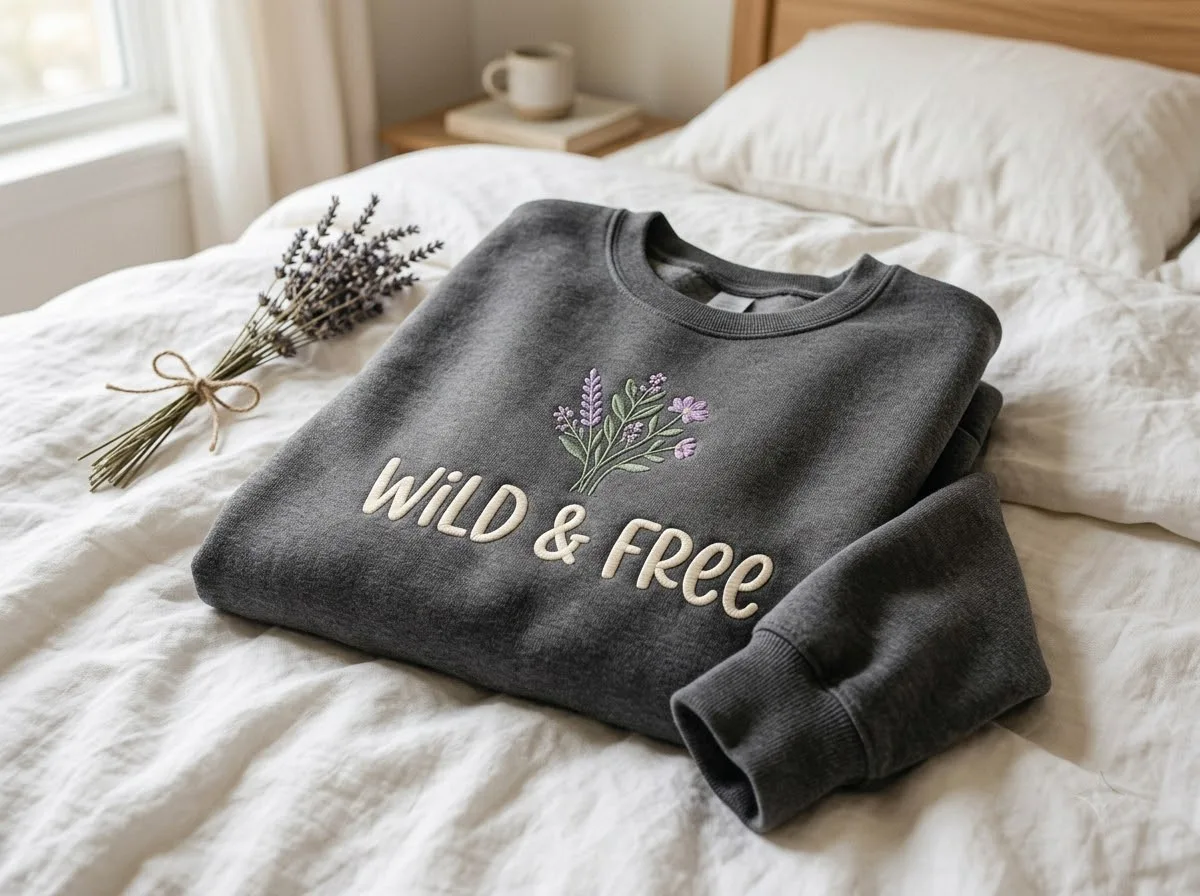
Gift ideas that rely on clean, deliberate lettering
When you’re ordering or making an embroidered sweatshirt as a gift, the font choice is part of the message. Clean, intentional lettering signals care and quality in a way that messy, over-detailed fonts never can.
A customized piece, like a mama sweatshirt with names embroidered, needs to be legible across all the names included. This is where a clean, small-block sans-serif font is essential—each name stays clear without crowding the design.
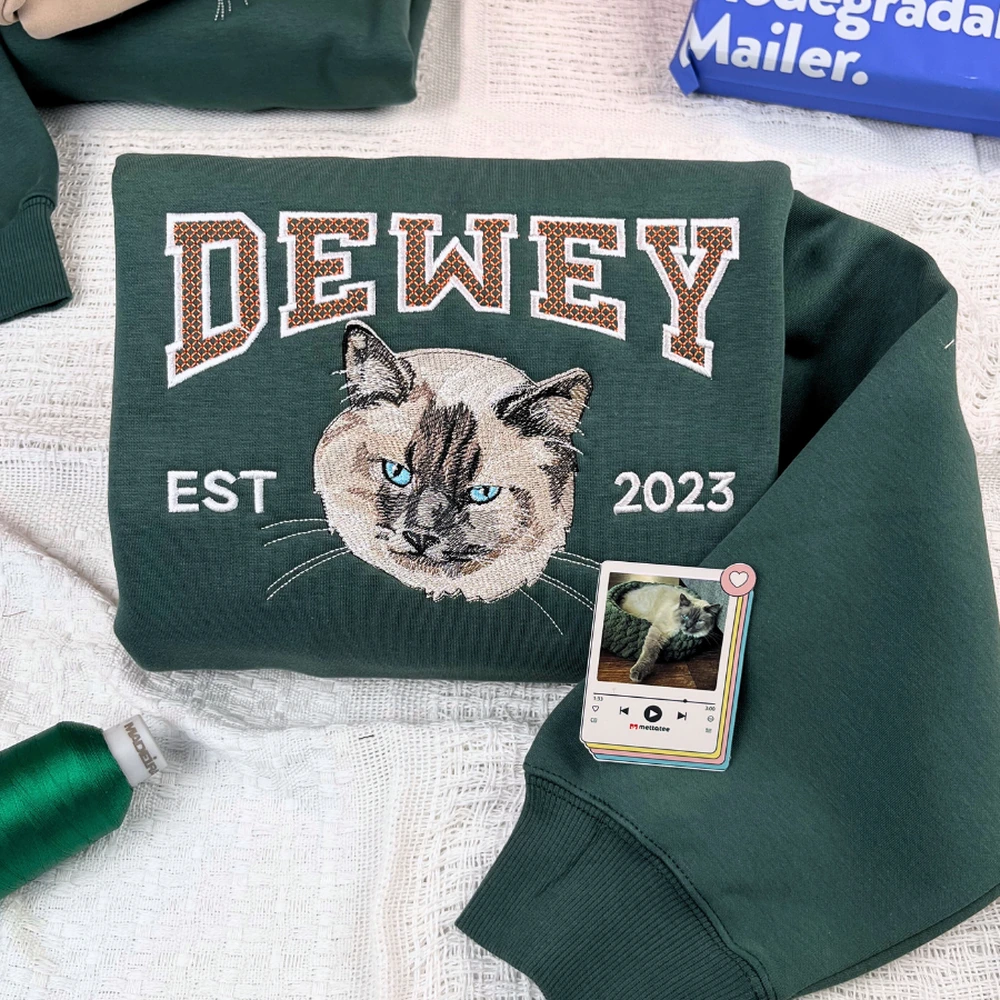
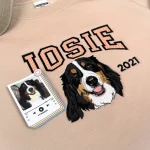
A thoughtful custom gift where clear lettering below the portrait adds a personal, polished touch.
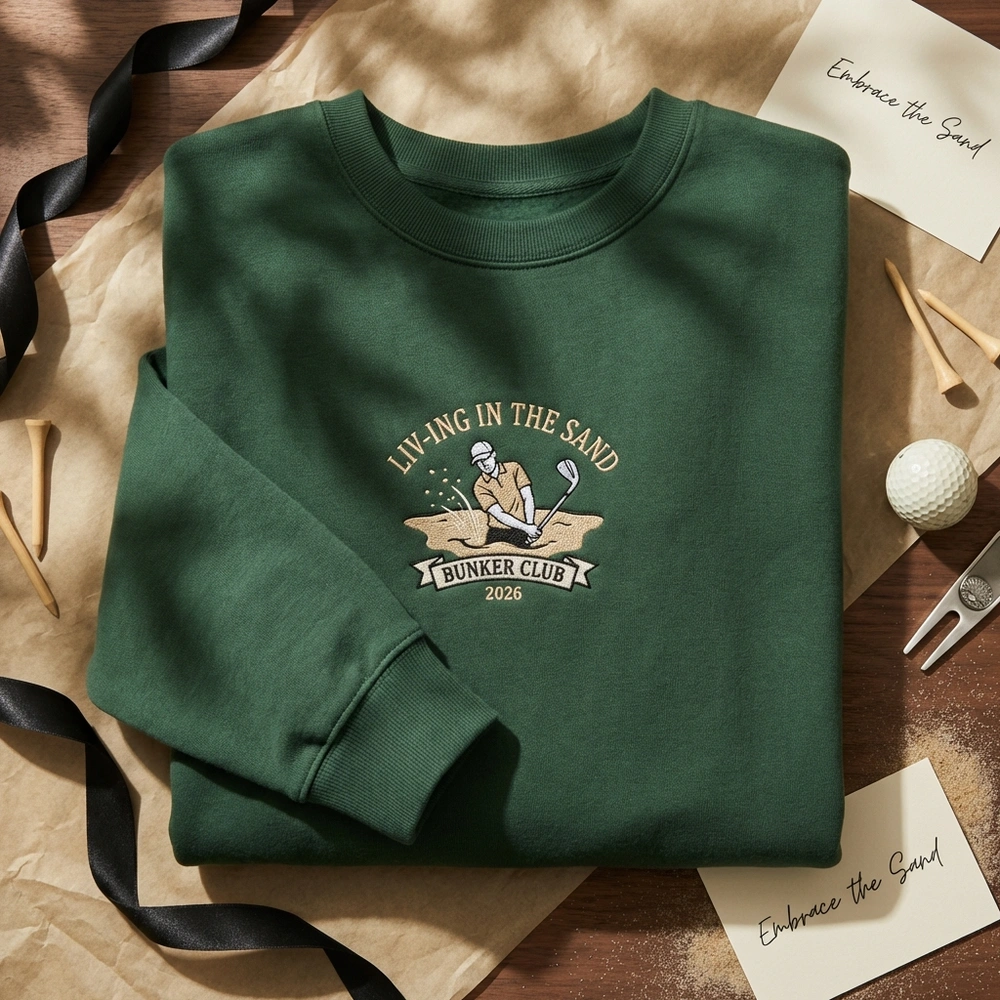
A fun, themed sweatshirt where bold, clear block lettering perfectly matches the humor of the design.
For a more unique gift, consider a thematic piece like the Sweater Curse Meme Embroidered Sweatshirt, where the style of the font is integral to the joke and the overall aesthetic of the garment.
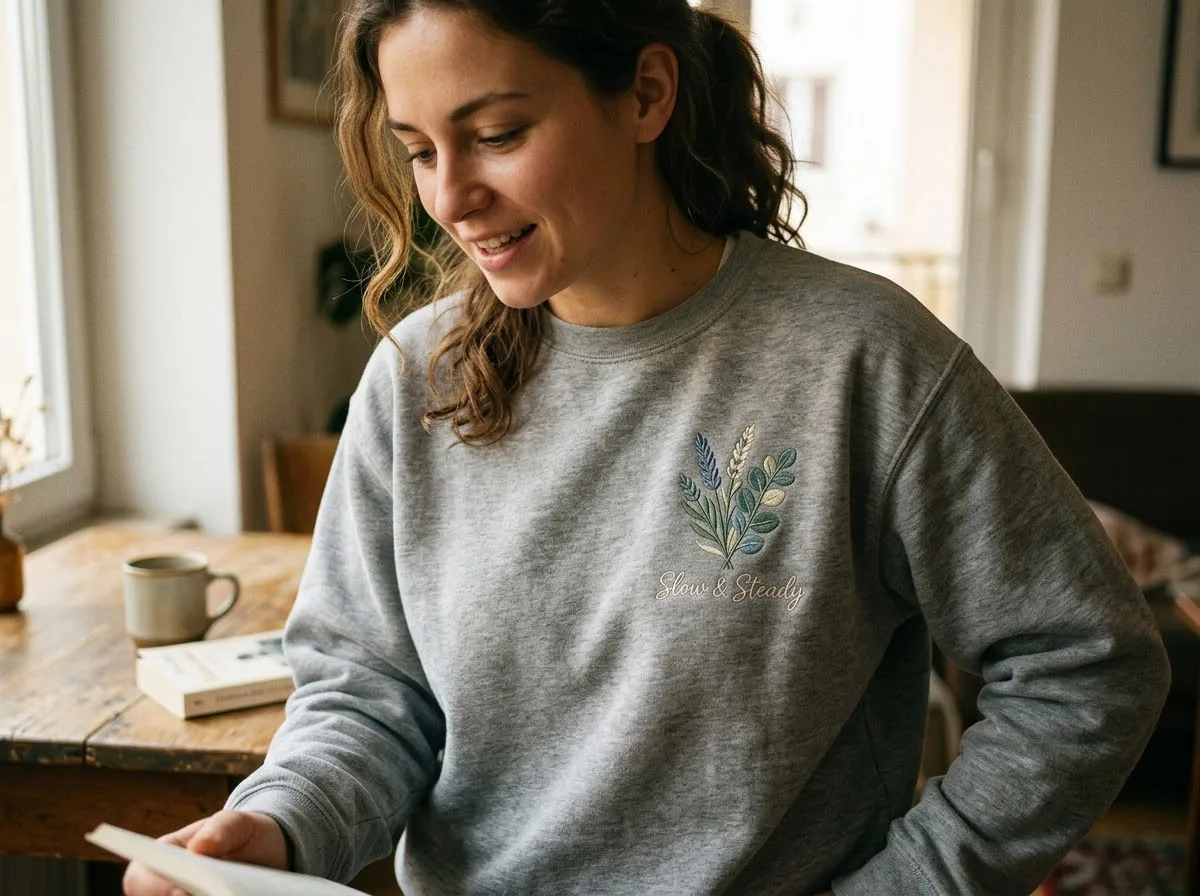
Frequently asked questions
What is the best font style for embroidered names on a sweatshirt?
The best font style for names is a clean, sans-serif block font, such as an Arial-style or basic small-block font. Because names are often small, a sturdy sans-serif avoids the risk of thin letters or delicate serifs closing up or breaking during the embroidery process.
Can I use any TrueType font for machine embroidery on a sweatshirt?
While many TrueType fonts can be converted for embroidery, they often fail on thick fabrics. Many have lowercase letters that are too small (about 70% of the capital height) to stitch neatly unless significantly enlarged. Always use fonts specifically digitized for embroidery, which have recommended stitch-size ranges.
Do I need a special stabilizer for embroidering on fleece?
Yes, fleece requires a cut-away stabilizer for support and a water-soluble topping on the surface. The topping prevents the stitches from sinking into the fuzzy nap of the sweatshirt, ensuring the design stays crisp and legible.
What thread weight is best for small text on an embroidered sweatshirt?
Standard 40-weight thread works for most designs but requires a minimum block letter height of 6–7 mm. For very small text, use 60-weight thread, which allows you to stitch letters as small as 3 mm, provided you use a #65 needle and adjust your machine's tension.