Here’s the test: ask a room of adults to name a famous Mother Goose rhyme and how many get past “Humpty Dumpty”? Fewer than you’d think. Most people can hum two or three lines and then trail off, which is exactly why the ones that survive are the ones that survive visually — a wall, a moon, a fiddle, a black sheep. Those images stitch beautifully. The backstories, as it happens, are mostly noise.
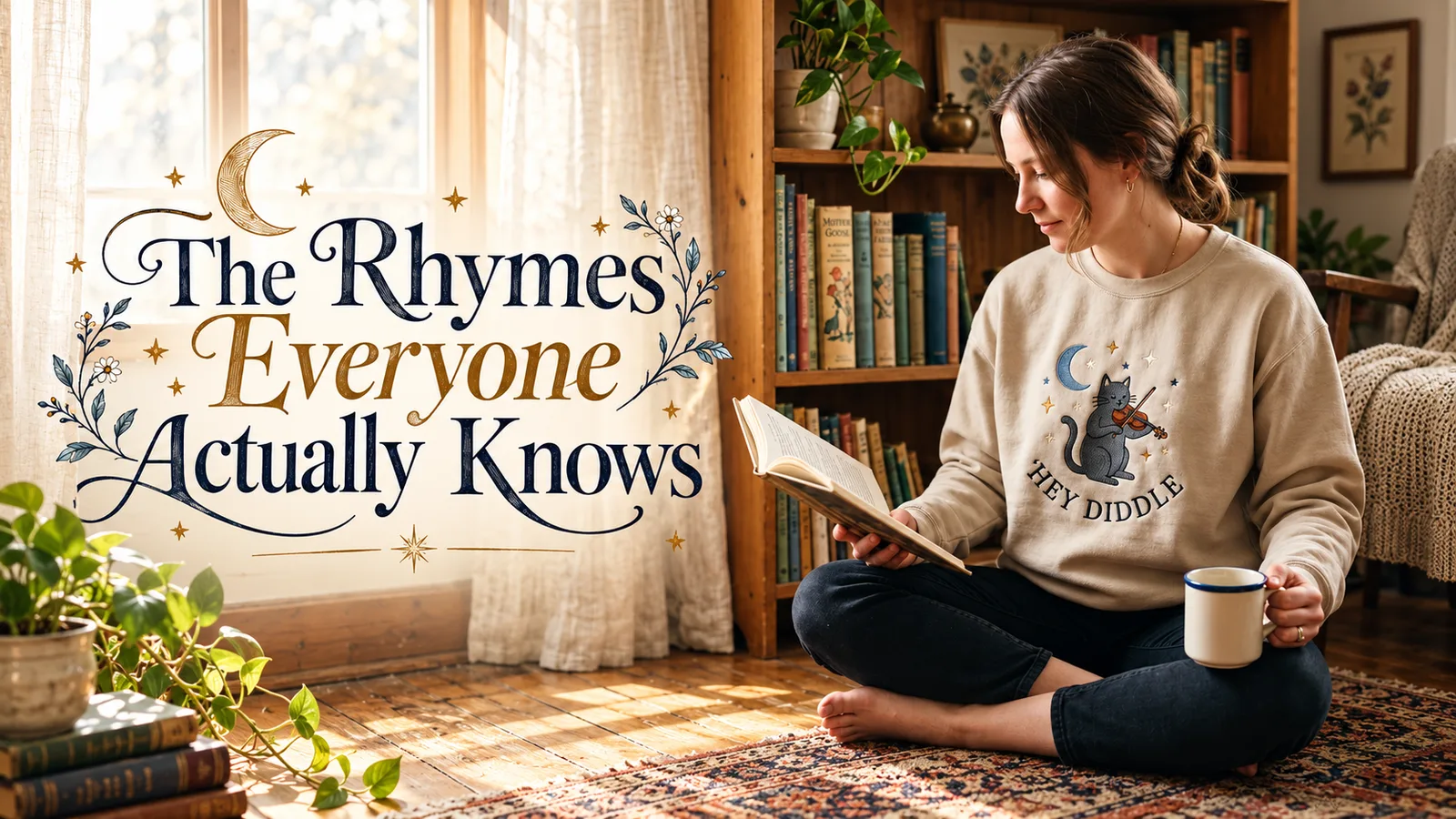
- Mother Goose is a legendary figure, not a documented author — the Library of Congress traces the name to 17th-century France and Charles Perrault's "Tales of Mother Goose."
- The rhymes Americans use as "Mother Goose" are a specific, documented set: Humpty Dumpty, Hey Diddle Diddle, Baa Baa Black Sheep, Hickory Dickory Dock, Jack and Jill, Mary Mary Quite Contrary, Hush Little Baby, and more.
- Nursery rhymes are early-literacy tools, not filler — rhyme, alliteration and syllable play build the phonological awareness that predicts reading success.
- The most embroidery-friendly Mother Goose imagery is simple and iconic: a wall, a cow, a fiddle, a clock, a hill. Avoid designs that depend on fine detail or long text.
- Skip the 'hidden meaning' theories. For apparel, visual nostalgia and pre-reading value are the defensible angles.
Mother Goose isn't a person — she's a publishing tradition
Mother Goose is a legendary figure, not a verified historical author. She began as a fairy-tale narrator associated with Charles Perrault’s 17th-century French collection Contes de ma Mère L’Oye — “Tales of Mother Goose” — and only later became shorthand for English-language nursery rhymes.
The Library of Congress research guide on Mother Goose makes the point cleanly: in the United States, “Nursery Rhyme” and “Mother Goose Rhyme” are used almost interchangeably. Most people using the phrase aren’t making a historical claim at all. They’re reaching for a mood — storybook, lap-time, gilt-edged.
The pivot into English rhyme happened through the print trade. The Poetry Foundation’s Mother Goose entry traces Mother Goose’s strong association with nursery rhymes to Mother Goose’s Melody; or, Sonnets for the Cradle, tied to publisher John Newbery’s circle, with Newbery’s popularizing edition dated to 1781. Books made her a personality. Songs made her a category.
Because the figure is invented, you get to be generous about the canon. Nobody can tell you that your grandmother’s favourite rhyme was illegitimate. Pick the imagery, not the scholarship.
The rhymes people actually name
Ask adults to list famous Mother Goose nursery rhymes and a recognisable core repeats: “Humpty Dumpty,” “Hey, Diddle, Diddle,” “Baa, Baa, Black Sheep,” “Hickory, Dickory, Dock,” “Jack and Jill,” “Mary, Mary, Quite Contrary,” “Hush Little Baby,” “Ride a Cockhorse to Banbury Cross,” and “There Was an Old Woman Who Lived in a Shoe.”
That list isn’t my invention — it’s the documented cluster collected under Nursery Rhymes on the Poetry Foundation. Notice what it has in common: almost every entry can be staged in a single image. That is the whole reason this particular body of literature keeps showing up on onesies, classroom posters and embroidery hoops.
| Rhyme | The image it gives you | Stitchability |
|---|---|---|
| Humpty Dumpty | Egg-shaped figure seated on a brick wall | Excellent — bold shape, one background element |
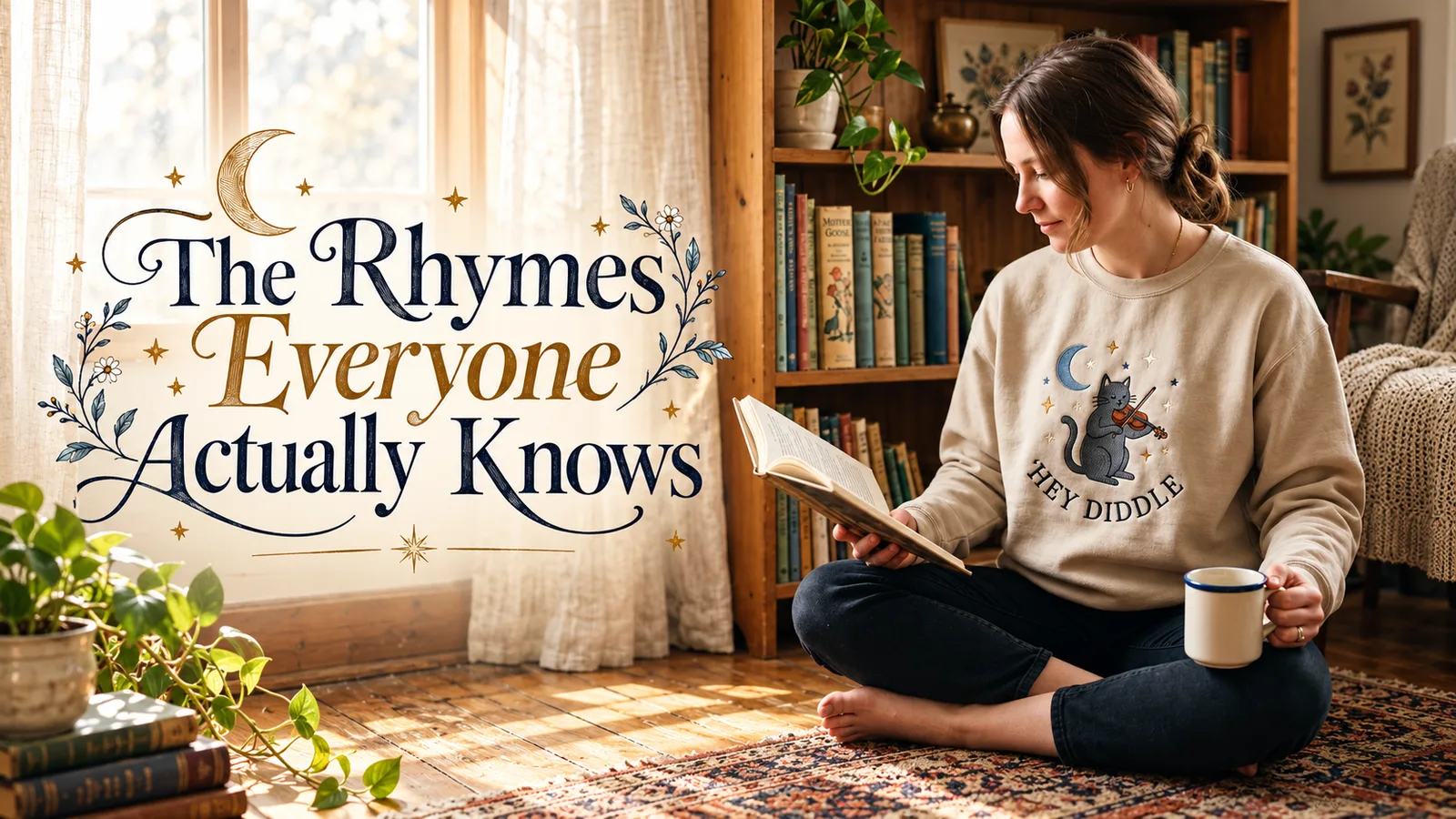
| Hey, Diddle, Diddle | Cat with a fiddle, cow jumping over the moon | Excellent — small figures, lots of negative space |
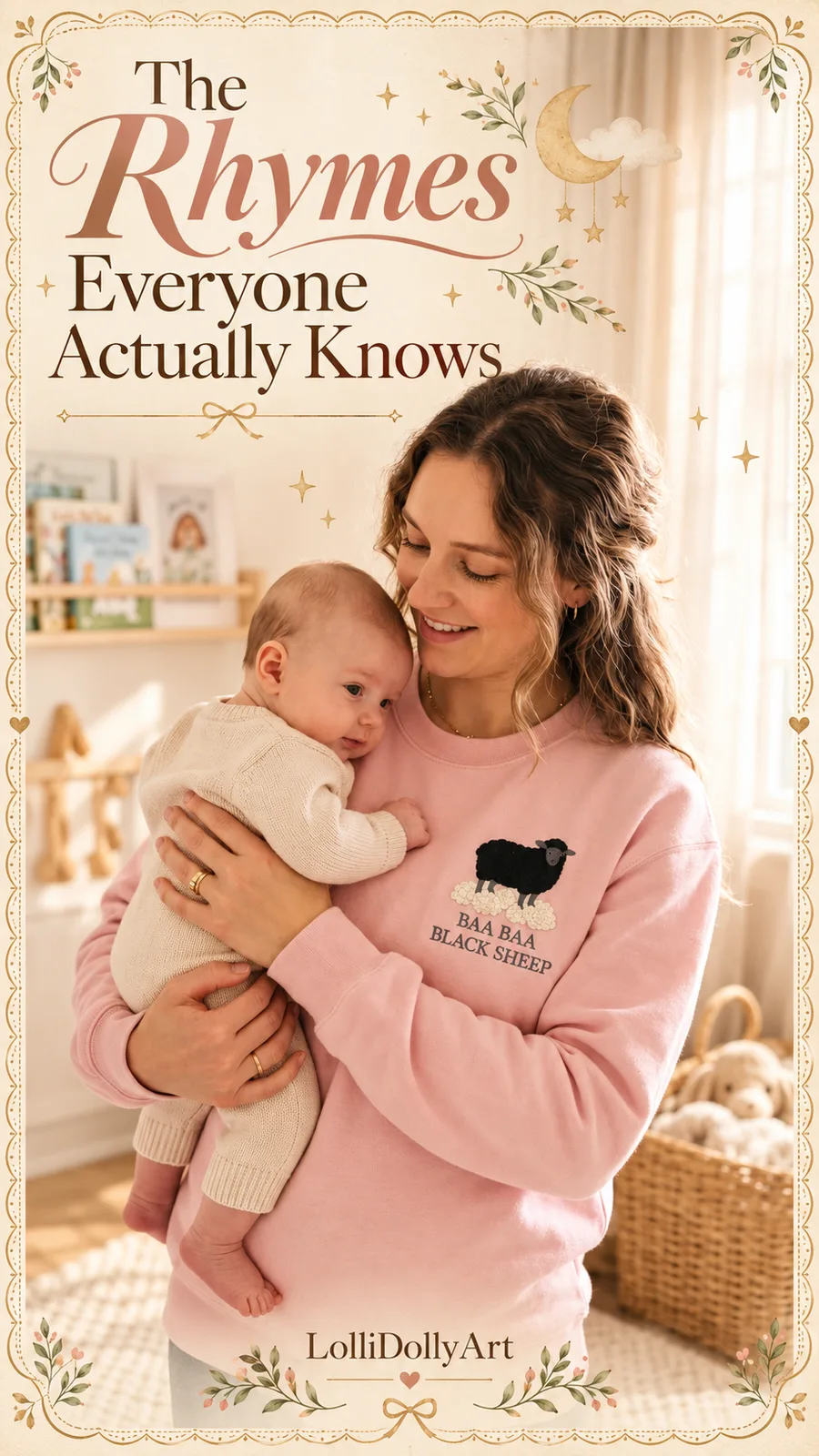
| Baa, Baa, Black Sheep | Three sheep, one black, a bag of wool | Very good — reads instantly at small scale |
| Hickory, Dickory, Dock | Clock on a wall, a mouse running down the hour | Good — compact and iconic |
| Jack and Jill | Two children on a steep hill, a pail between them | Fair — figures need simplification |
| Mary, Mary, Quite Contrary | A walled garden of flowers and sprouts | Very good — motif-driven, no faces required |
| Hush Little Baby | A cradled infant, stars, a lullaby mood | Good — a phrase works better than a scene |
| There Was an Old Woman Who Lived in a Shoe | An oversized shoe with a family inside | Fair — the shoe is the hero, keep the rest as linework |
The core canon, and the one visual each one hands you
In the U.S., "Nursery Rhyme" and "Mother Goose Rhyme" are used interchangeably — which is why the category feels endless even though the source is finite.— Library of Congress
Why teachers still hand these out on purpose
Nursery rhymes are early-literacy infrastructure, not nostalgia filler. Rhyming, alliteration, syllable play and sound games all build phonological awareness — the ability to hear and manipulate the sounds inside words, which is one of the strongest predictors of early reading success.
Reading Rockets’ explainer on phonological and phonemic awareness breaks the skill down into workable pieces: rhyming, alliteration, syllable segmentation, blending. Mother Goose lines happen to deliver all four in the same breath. “Hickory, dickory, dock” is a syllable-segmentation drill. “Baa, baa, black sheep” is pure rhyme discrimination. Three little pigs is a consonant-vowel consonant exercise dressed as a fable.
Research indexed in ERIC on nursery rhyme knowledge and phonological awareness in preschool children reports that familiarity with nursery rhymes supports rhyme sensitivity and phonemic skill development in preschoolers. If you’re buying for a teacher, a librarian, a preschool family or a new baby, that reframes a decorative sweatshirt as something a kid might actually read off the chest out loud.
Choose a rhyme whose words are short enough to sit under a chest design in one or two lines. A sweater a preschooler can say from memory does more good than a beautiful abstract quilt of the same size.
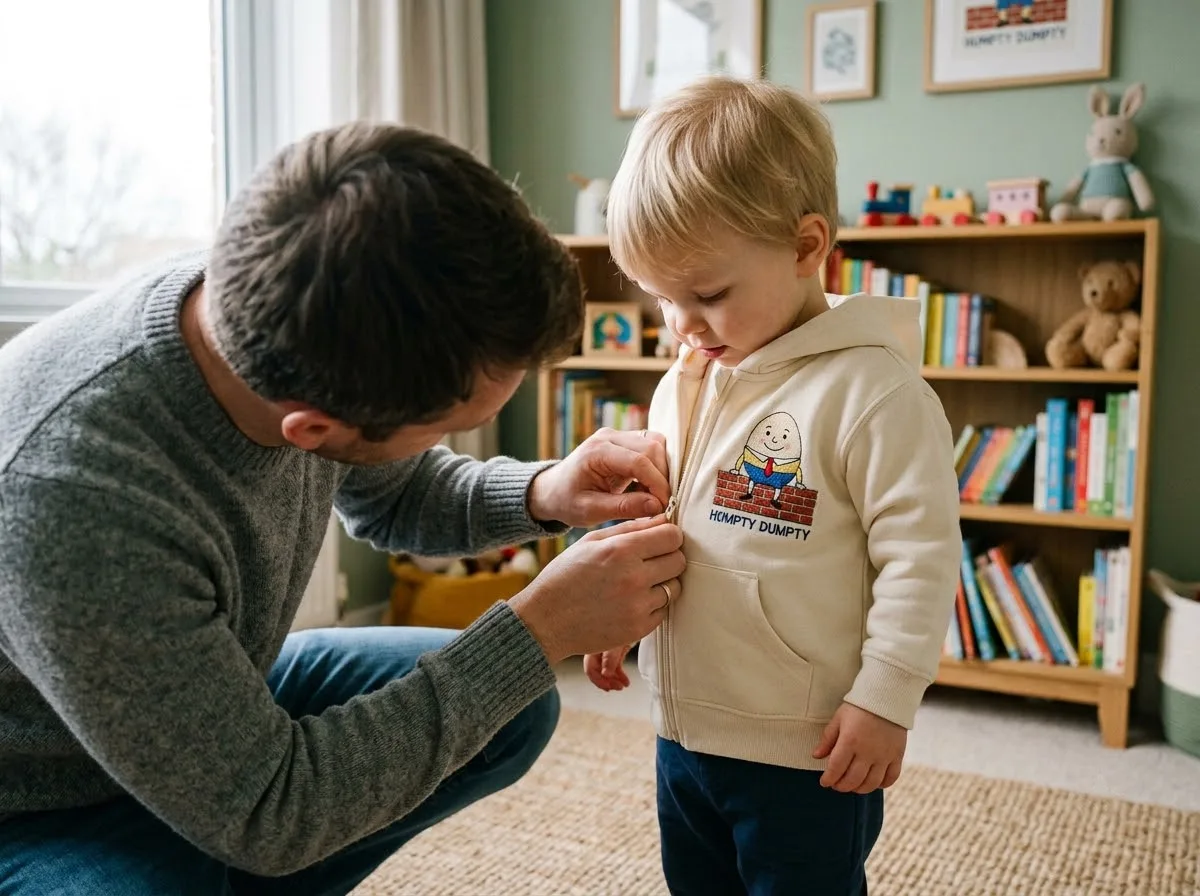
The motifs that survive machine embroidery
The strongest Mother Goose designs use imagery that is instantly recognisable and physically simple: Humpty on a wall, a cow jumping over the moon, a cat with a fiddle, black sheep and wool, clock-and-mouse from “Hickory Dickory Dock,” a Jack-and-Jill hill, and garden motifs from “Mary, Mary, Quite Contrary.”
That list comes from the Poetry Foundation nursery rhyme collection, read with an embroiderer’s eye. Embroidery rewards silhouettes and punishes detail. A cat holding a fiddle is four thread colours and a happy afternoon. A cat in a room with a shoe and a moon and a dish of curds and whey is a digitising headache that will look muddy at 20mm tall.
- One contained unit on the chest. Roughly a quarter of the chest width, centred. A design that needs the whole panel stops reading as embroidery and starts reading as wallpaper.
- Three to six thread colours. Enough to be charming, few enough to keep the fill stitches dense and crisp.
- Type under 40mm tall. Any longer and satin-stitch lettering fills in and the counters close up.
- Big shapes, small detail. Satin stitch for the wall, the moon, the black sheep. Run-stitch linework for hems and stems only.
- Check the background. Standalone motifs survive an off-white or coloured garment. A full scene behind a rhyme needs a very calm shirt colour.
Before you commit to any Mother Goose purchase, it’s worth reading the fuller mother goose shirt breakdown — it covers garment weight, sizing and how to check the design quality before you commit to a custom order. This article is about which rhyme and why; that one is about the shirt itself.
Where to actually buy, by who's wearing it
Match the rhyme to the wearer rather than hunting for a generic gift. Goose-themed humour suits adults, classic nursery imagery suits babies and classrooms, and a single strong word or motif is the safest bet when you don’t know the size or the taste.
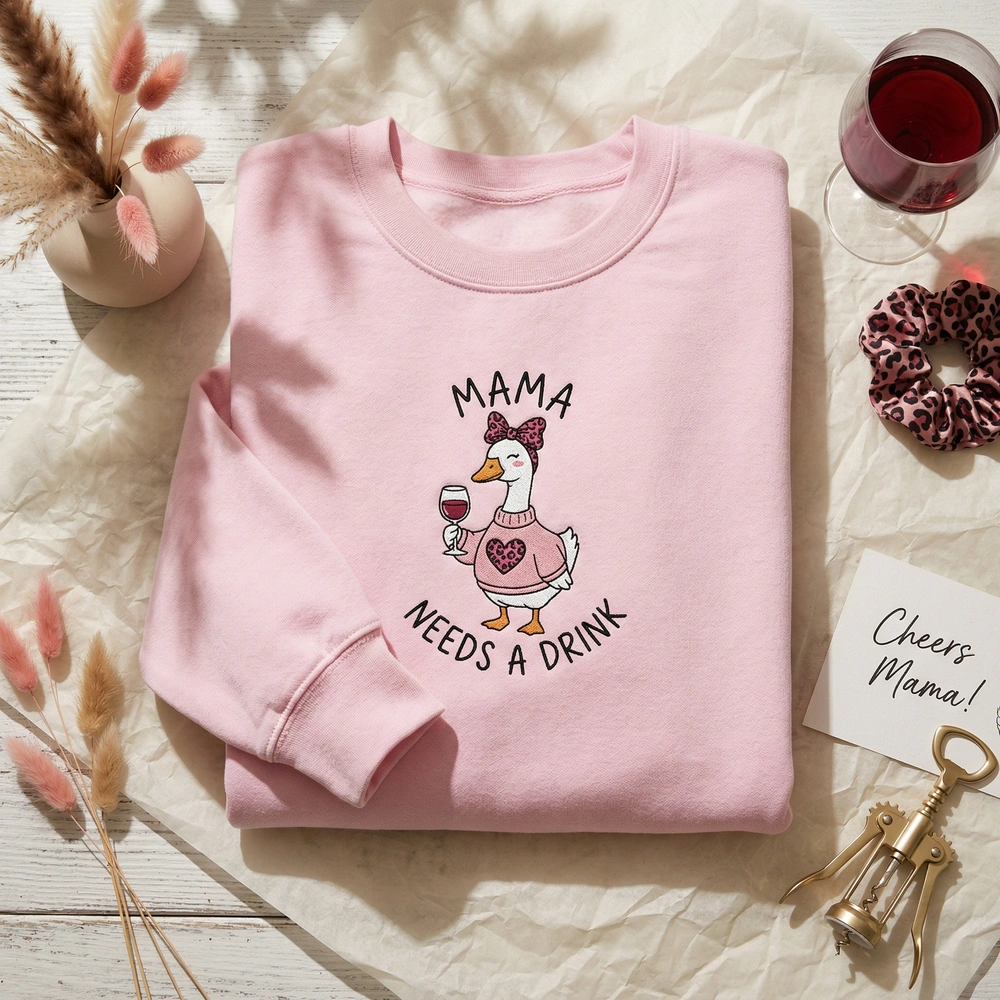
The grown-up entry point — Mama Goose energy with a Mother's Day handle, and it works as a real sweatshirt rather than a costume.
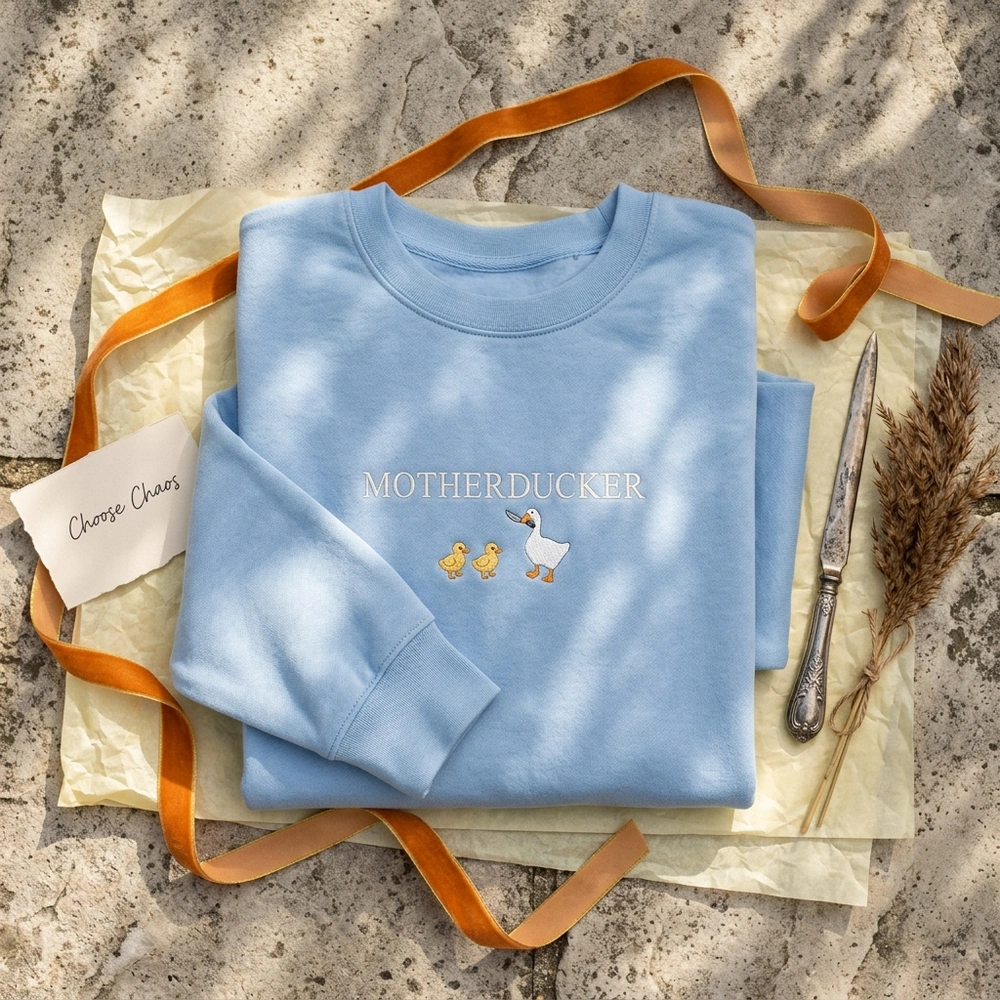
If the gift recipient is the kind of adult who explains a joke, this is the one. Peak goose, zero nursery-rhyme sentimentality.
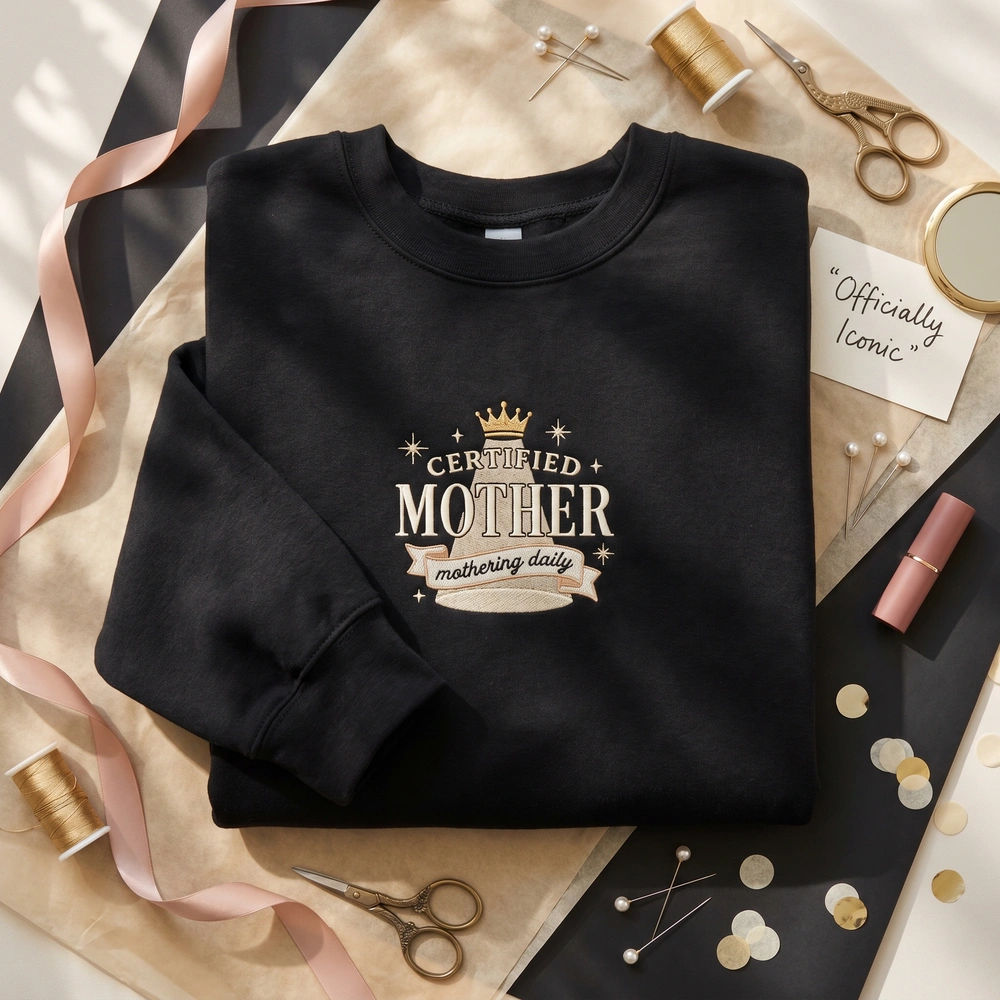
Best for Mother's Day when you want warmth and a bit of wit — a single chest design that reads clearly across a room.
There’s also a very good reason to keep the nursery rhymes off the adult’s garment. A Mother Goose design on a three-year-old’s hoodie gets read. The same design on a forty-year-old’s sweatshirt gets explained at a party. If you want the rhyme on a grown-up, the House of Mother sweatshirt is the move — a single embroidered word, a small stitched design unit, nothing that needs explaining.
Show the design to someone who wasn’t in the conversation. If they name the rhyme in three seconds, it works at that stitch count. If they squint, add contrast thread or drop a line of text — don’t add detail.

Skip the conspiracy theories
Online “hidden meanings” behind nursery rhymes — political, grim, or sexual — are contested at best and repeated far past their evidence. For apparel, visual nostalgia, early-literacy value and recognisable storybook motifs are the defensible angle.
Origin stories for these rhymes are genuinely disputed; the background on how nursery rhymes developed and why so many had uncertain authors is laid out in the nursery rhyme overview on Wikipedia. You will not be fact-checked into a corner by linking a shelf-stable source, and you won’t accidentally hand a two-year-old a sweatshirt with a political thesis on it. That is a real merchandising consideration, not just an editorial one.
Once you’ve chosen a rhyme, the remaining question is how to wear it. The Mother Goose graphic tee styling guide covers the layering and proportion side, and if you’re shopping for someone else, Mother’s Day gift ideas beyond flowers and mugs will keep you away from the third identical scented candle.

Quick questions
Who wrote the Mother Goose nursery rhymes?
No single verified author. "Mother Goose" is a legendary figure, traced by the Library of Congress to Charles Perrault's 17th-century French tales, who was later attached to English nursery rhyme collections published in the 1700s.
What are the most famous Mother Goose rhymes?
Humpty Dumpty, Hey Diddle Diddle, Baa Baa Black Sheep, Hickory Dickory Dock, Jack and Jill, Mary Mary Quite Contrary, Hush Little Baby, Ride a Cockhorse to Banbury Cross, and There Was an Old Woman Who Lived in a Shoe.
Are nursery rhymes actually good for a child's development?
Yes — rhyme, alliteration and syllable play build phonological awareness, a core pre-reading skill. Research indexed by ERIC links nursery rhyme knowledge to stronger rhyme sensitivity and phonemic skills in preschoolers.
Which Mother Goose designs work best in machine embroidery?
Simple, iconic ones: Humpty on a wall, a cow over the moon, a cat with a fiddle, black sheep, clock and mouse, a garden. Keep the design contained, three to six thread colours, and lettering under about 40mm tall.