Most quote lists for Lord of the Flies make the same mistake. They pull a line out of the book, drop it on a page, and leave you guessing who said it, when, and why it matters. That’s useless when you’re writing an essay or studying for a test. A quote without its scene is just a sentence. This guide works the other way around. For each passage, you get the chapter, the speaker or narrator, what is happening in the story, and the theme it supports. I spend my days turning literary symbols into embroidery designs, so I read this book closely. I’ve also added a short, honest section on putting quotes onto apparel, because that question comes up more than you’d think.

- Lord of the Flies was published in 1954 and has 12 chapters; a useful quote guide names the speaker and explains the scene for each line.
- Chapter 4's stone-throwing scene shows Roger still held back by the memory of parents, school, police, and law.
- Simon's “Maybe it's only us” (Chapter 5) and the pig's head's “I'm part of you?” (Chapter 8) both place the beast inside the boys rather than outside them.
- Jack's “We don't need the conch anymore” (Chapter 6) marks the shift from shared rules toward authoritarian leadership.
- A short quotation is not automatically cleared for commercial use; symbol-based designs like the conch or broken glasses avoid that question entirely.
How to read a quote guide for this novel
William Golding’s Lord of the Flies was published in 1954 and runs 12 chapters. The quotes worth knowing are the ones you can place: who speaks, what is happening, and what the line reveals about the boys or the island (Wikipedia).
Study guides like eNotes organize quotations with the speaker and context attached, and that’s the right standard. A teacher grading your essay doesn’t want to see that you found a famous line. They want to see that you understand why Golding put it there, in that chapter, coming from that character.
This guide focuses on five passages from the middle of the book, Chapters 4 through 8. That stretch is where the story turns. The boys go from a group still governed by habits they brought from home to a group ready to believe a beast lives among them. If your essay is about civilization versus savagery, fear, or human nature, most of your evidence will come from here.
- Chapter: anchors the quote in the story’s timeline, so you can show change over time.
- Speaker or narrator: a line from Simon carries different weight than the same idea from Jack.
- Scene: what is physically happening when the words are spoken.
- Theme: the larger idea the quote supports in an argument.
I’ve only included passages I could verify against published study guides. For Chapters 1–3 and 9–12, check exact wording against your own edition and a source such as SparkNotes before you cite anything. Page numbers vary between printings, so always quote from the copy your class uses.
Chapters 4 and 5: the old rules hold, then the fear turns inward
In Chapter 4, Roger throws stones near the younger boy Henry but deliberately misses, held back by the lingering influence of parents, school, police, and law. In Chapter 5, Simon suggests the beast may be “only us,” moving the source of fear from the jungle to the boys themselves (SparkNotes).
Chapter 4: Roger and the stones
This is a narrator’s passage, not dialogue, and that matters for how you cite it. Roger throws stones toward Henry, but he aims to miss. The narrator explains why. Around Henry is an invisible space that Roger doesn’t dare enter, protected by the memory of parents, school, police, and law. According to SparkNotes, the passage shows social restraints that have not yet completely broken down.
That “not yet” is the whole point. Use this passage when you need to show where Roger starts. It’s evidence that civilization on the island survives as a habit and not a belief. The rules work only because the boys still remember the people who enforced them. Pair it with any later scene of Roger’s cruelty and you have a clean before-and-after argument.
Chapter 5: “Maybe it's only us.”
Simon says this during an assembly where the boys argue about whether the beast is real. Everyone else is looking outward, at the jungle, the sea, the dark. Simon suggests the beast might be inside them. SparkNotes’ Simon quotes page notes that this locates the feared beast within the boys themselves rather than in an external monster.
Four words, and it’s arguably the thesis of the novel spoken out loud. It’s also worth noticing who says it. Simon is the quiet one, the boy the others find odd. Golding gives the most important insight in the book to the character least able to make the group listen. That’s a strong point to raise in an essay about how groups treat uncomfortable truths.
“Maybe it's only us.” Simon, Chapter 5— SparkNotes
Chapter 6: Jack throws out the conch
In Chapter 6, Jack declares, “We don’t need the conch anymore.” By rejecting the shell that gives each boy the right to speak, he challenges the group’s shared rules and signals a move toward authoritarian leadership (SparkNotes Chapter 6 Quotes).
The conch is the island’s first piece of government. Whoever holds it gets to talk, and everyone else listens. It’s a simple rule, and it only works if everyone agrees to it. When Jack says the group doesn’t need it, he isn’t just being rude in a meeting. He’s saying the agreement itself is optional.
SparkNotes frames this as the movement away from shared decision-making toward authoritarian leadership. For your essay, that’s the cleanest single line to show the political split between Ralph and Jack. Ralph’s authority comes from the rule. Jack’s comes from whoever is willing to follow him.
Don’t just quote Jack. Say what the conch represented before this moment, then show what Jack is rejecting. The quote lands harder when your reader already understands the shell as a symbol. If you need a refresher, our breakdown of what the conch, glasses, fire, and beast really mean covers each symbol in depth.

Chapters 7 and 8: Simon's reassurance and the pig's head
In Chapter 7, Simon tells Ralph, “You’ll get back all right. I think so, anyway,” a line that becomes ominous because Simon says “you” rather than “we” and does not survive the island. In Chapter 8, the pig’s head asks Simon, “I’m part of you?”, making the link between the beast and human evil explicit (SparkNotes).
Chapter 7: “You'll get back all right. I think so, anyway.”
Ralph is low, missing home, and Simon tries to comfort him. On a first read, it sounds like a kind, slightly awkward thing to say. On a second read, it’s hard to forget. As SparkNotes points out, the distinction between “you” and “we” makes the reassurance ominous in retrospect, because Simon does not make it off the island.
This is a good quote for essays on foreshadowing or on Simon as a prophet-like figure. Point to the pronoun specifically. Close reading at the level of a single word is the kind of detail that separates a strong analysis from a summary.
Chapter 8: “I'm part of you?”
Alone in a clearing, Simon faces the pig’s head the hunters left on a stick, the object the book is named for. What follows is an imagined conversation in which the head speaks to him. SparkNotes’ page on the Lord of the Flies symbol explains that this exchange makes the connection between the beast and the evil within human beings explicit. The head is a symbol, not a literal monster.
Notice how this scene answers Chapter 5. Simon guessed, “Maybe it’s only us.” Three chapters later, the symbol of the beast confirms it. If you’re building an argument about human nature, quoting both lines together shows how Golding develops the idea instead of stating it once.
A common essay slip is writing as though the pig’s head literally talks. Frame it as an imagined or hallucinated conversation, and treat the head as a symbol. That reading is both more accurate and more interesting.
The five passages at a glance
Each of these passages supports a different essay argument: Chapter 4 for restraint, Chapters 5 and 8 for inner evil, Chapter 6 for the collapse of order, and Chapter 7 for foreshadowing. Use the table to match a quote to your thesis quickly.
| Chapter | Speaker | Quote or passage | Theme | Best essay use |
|---|---|---|---|---|
| 4 | Narrator (about Roger) | Roger throws stones near Henry but aims to miss, held back by parents, school, police, and law | Social restraint | Showing civilization as habit, not belief |
| 5 | Simon | “Maybe it's only us.” | Human nature, fear | The beast lives inside the boys |
| 6 | Jack | “We don't need the conch anymore.” | Order vs. power | Collapse of shared decision-making |
| 7 | Simon (to Ralph) | “You'll get back all right. I think so, anyway.” | Foreshadowing | Close reading of “you” vs. “we” |
| 8 | Pig's head (imagined, to Simon) | “I'm part of you?” | Evil within | Symbolism of the Lord of the Flies |
Lord of the Flies quotes by chapter, with speaker and best essay use
If you can only use two quotes, take Chapter 5 and Chapter 8. Together they trace Golding’s central idea from a hesitant guess to a direct confrontation, and both come from the same character. If your essay is about leadership instead, swap in Chapter 6 and contrast it with the Chapter 4 passage to show how far the rules have fallen.
Before you put a quote on a sweatshirt
Quoting a line in an essay and stitching it onto a product you sell are different situations. The U.S. Copyright Office says there is no fixed number of words that automatically makes a use fair, so even a short quotation shouldn’t be treated as cleared for commercial embroidery.
I get this question from readers all the time. Someone loves “Maybe it’s only us” and wants it embroidered across a hoodie. I understand the appeal. But the Copyright Office is clear that permission questions depend on the circumstances, and there’s no safe word count. A quote in a classroom essay with commentary is one thing. Selling that same line as a product is another.
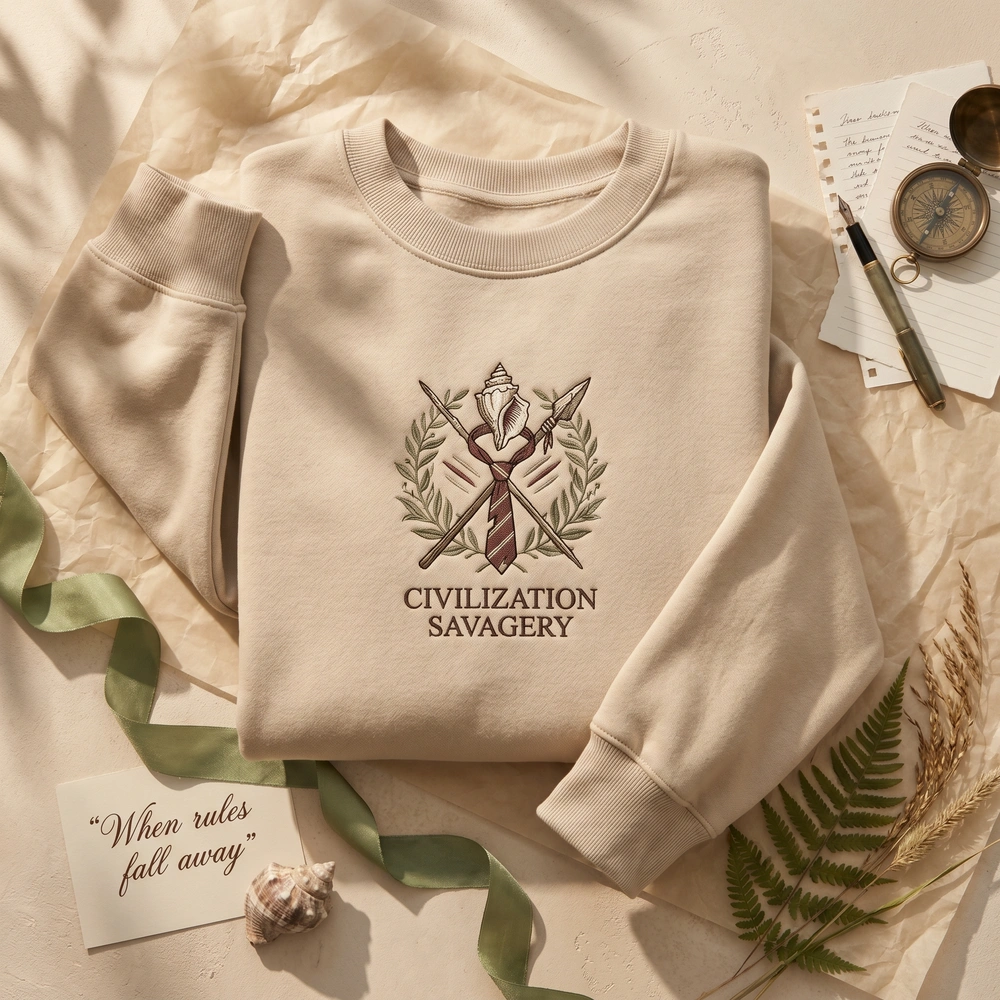
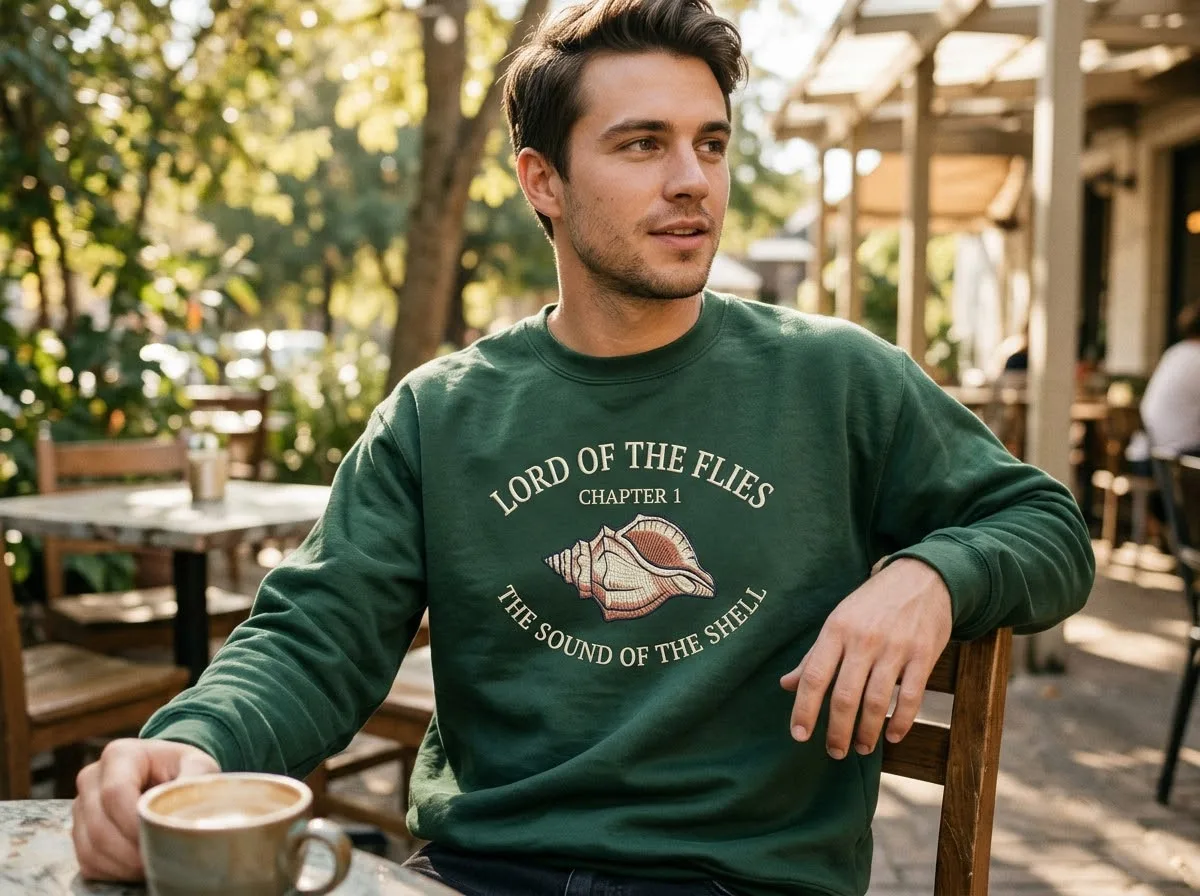
That’s why the pieces we make lean on the novel’s symbols instead of its text. A conch, a pair of cracked glasses, an island silhouette. Anyone who has read the book recognizes them instantly, and honestly, they read better in thread anyway. Long quotes get cramped at chest size. A single strong motif in satin stitch holds its shape and stays legible across the room. If you want the full comparison of what works, our buyer’s guide to lord of the flies merch walks through each symbol and the designs that do it justice.
Matching a design to the quote you love
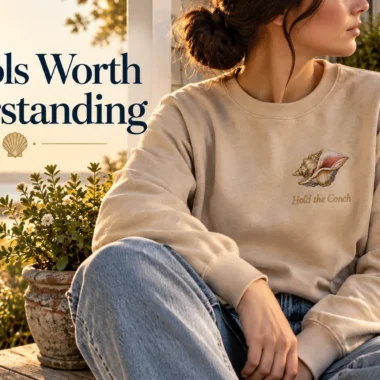
- If Chapter 6 is your favorite: the conch is the obvious pick. It’s the object Jack throws away and the symbol of every rule the boys abandon.
- If you’re drawn to the fall from civilization: broken glasses carry that story of reason and order breaking down.
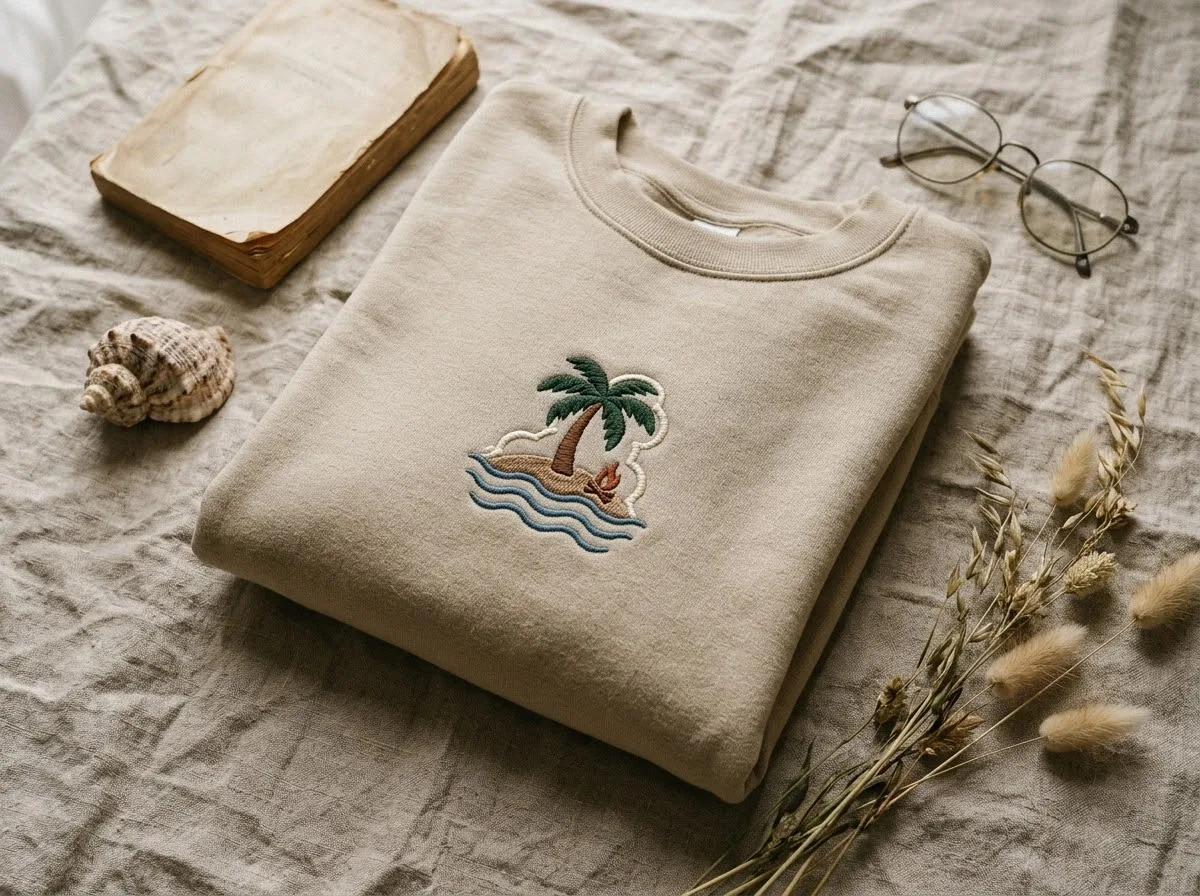
- If you want the whole book in one image: an island motif is the quietest, most versatile option, and works as a gift for anyone who loved the novel in school.
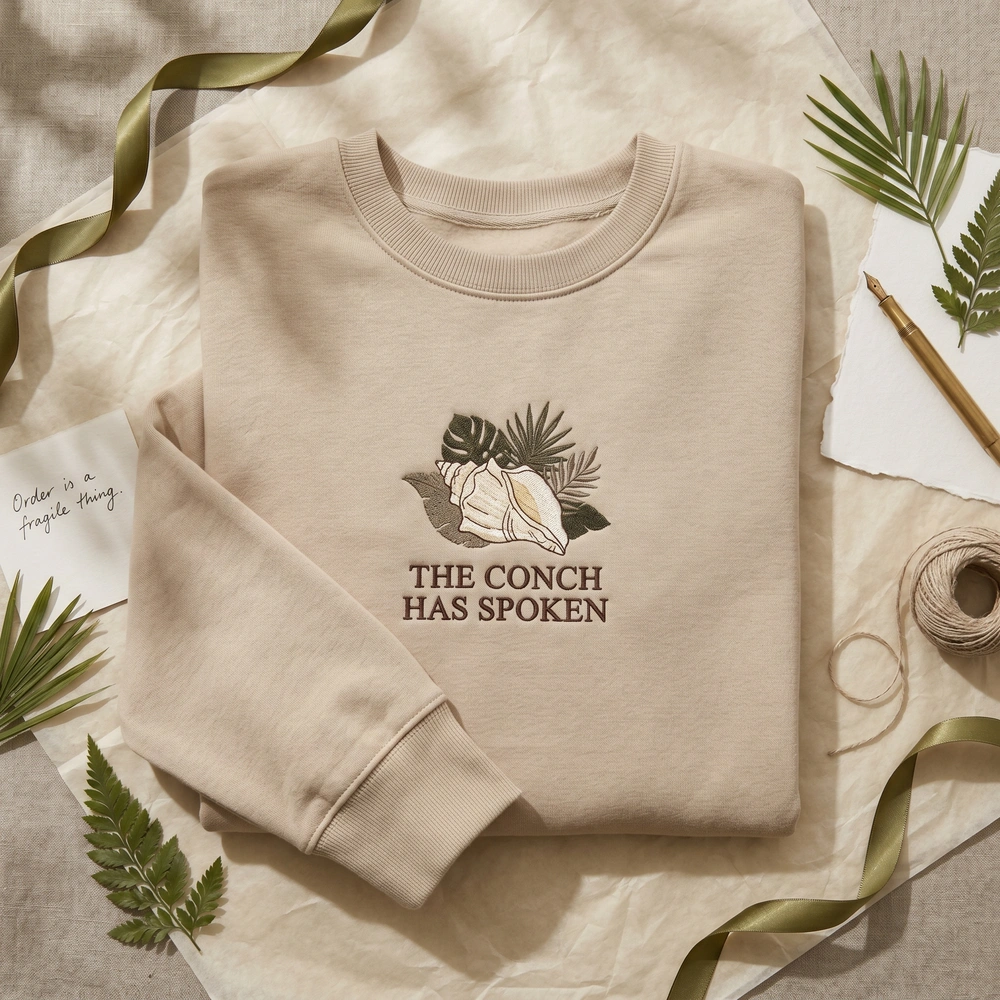
The conch from Chapter 6's turning point, stitched on a sand sweatshirt for readers who side with Ralph's rules.
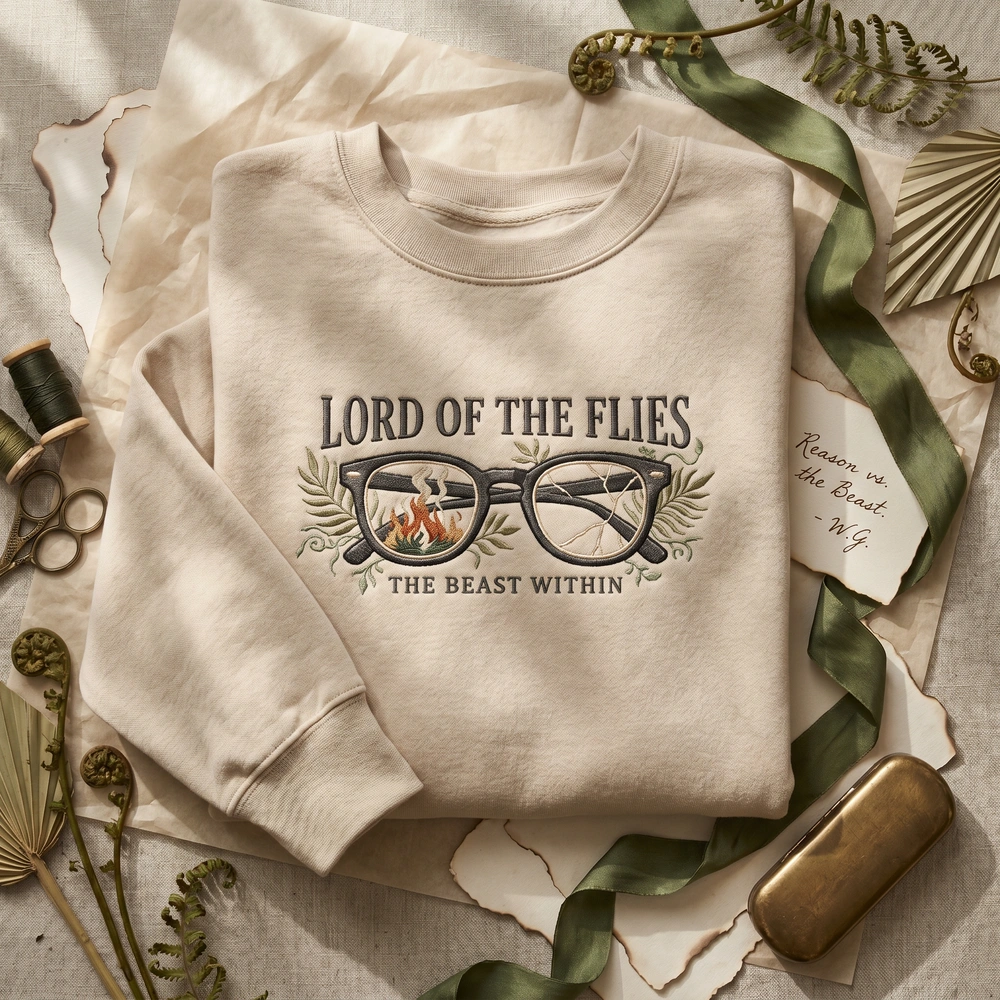
Cracked spectacles in clean machine embroidery, a subtle nod to reason giving way on the island.
An island symbol design that works for teachers, English majors, or anyone who still remembers reading it.
If you’re buying for someone and don’t know which scene stuck with them, go with the conch. It’s the most recognizable symbol in the book, and it starts conversations without needing an explanation.
Quick questions
How many chapters are in Lord of the Flies?
Twelve. William Golding published the novel in 1954, and it's divided into 12 chapters.
Who says “Maybe it's only us” in Lord of the Flies?
Simon says it in Chapter 5, suggesting the beast the boys fear is inside them rather than an outside monster.
What does the pig's head say to Simon?
In Chapter 8, during an imagined conversation, the pig's head asks Simon, “I'm part of you?” The line links the beast to the evil within people.
Can I sell a shirt with a Lord of the Flies quote on it?
Don't assume a short quote is automatically fine. The U.S. Copyright Office says no fixed word count makes a use fair, and it depends on the circumstances. Symbol-based designs avoid the question.